
What Does Working With an Agency on a Web App Look Like? A Step-by-Step Guide
Picture the owner of a wholesale business who ran orders out of spreadsheets for years. Every morning, the team retyped data between the online marketplace, the inventory tool, and the accounting system. One day he did the math: 11 hours lost every week. That's when he called a software house and asked the question we hear most often: "Okay, but what does working together actually look like? What do I do, and what do you handle?"
This article answers exactly that. We'll walk through web application development with an agency step by step - from the first conversation, through coding, to maintaining the finished system. No fluff, just the specifics you'll want before you ever sign a contract.
Why companies choose an agency over building in-house
Building your own IT department sounds appealing until you run the numbers. Hiring a senior developer can take months, and serious business application development needs a whole team, not one person: frontend, backend, UX designer, tester, DevOps. An agency hands you that team on day one.
The second advantage is cross-industry experience. A software house running custom software development for e-commerce, logistics, and SaaS in parallel already knows the traps your new team would only just be falling into. That's the difference between learning from your own mistakes and learning from someone else's.
At Nice Code, we treat software outsourcing as a partnership, not a "code by the yard" service. We take ownership of the business outcome - whether the app genuinely cuts order-handling time, not just whether it passes tests.
A good agency doesn't ask "which technology do you want?" first. It asks "what problem are you solving?" If you hear the reverse, that's a warning sign.
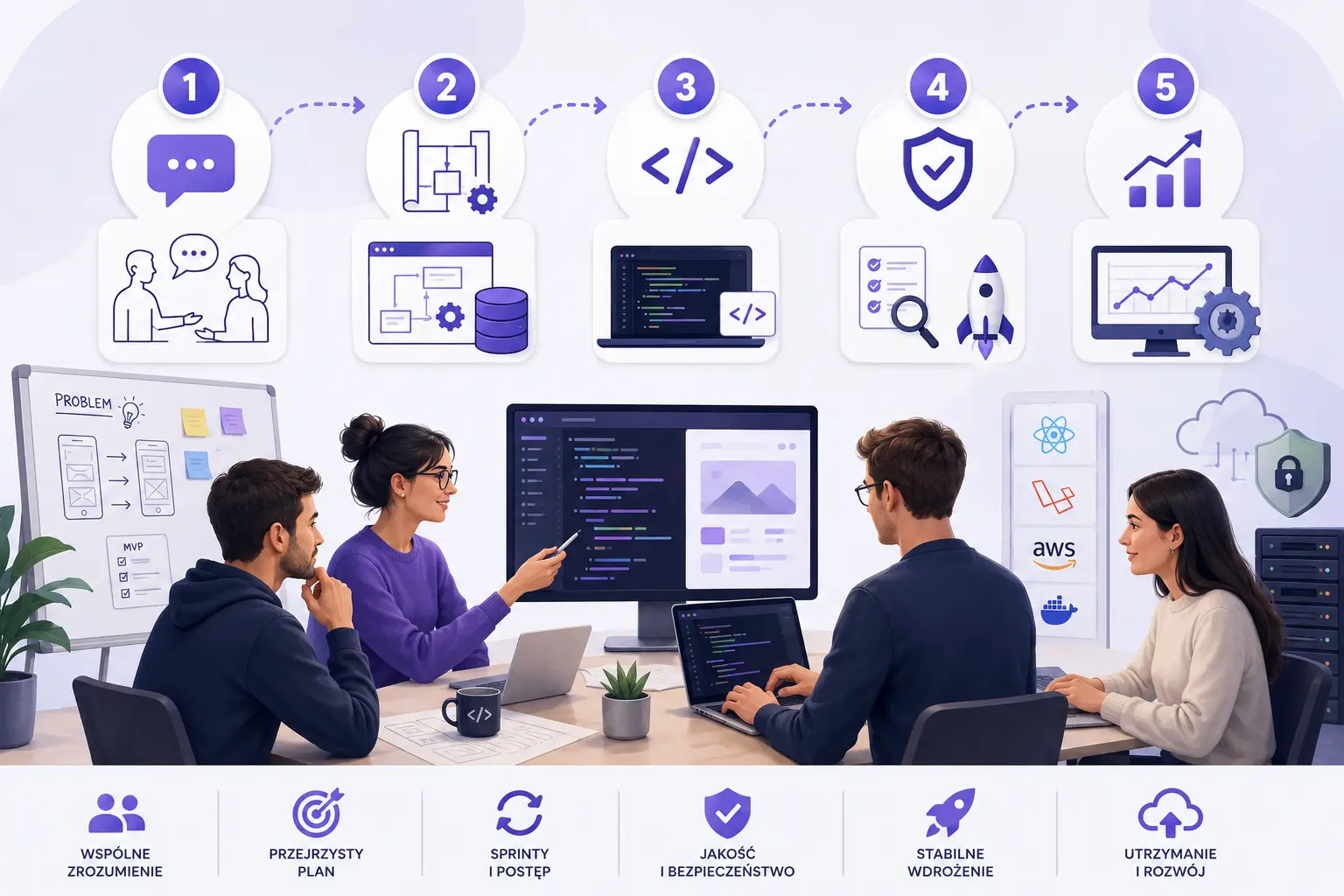
Step 1: Discovery - a conversation, not a number pulled from a hat
Working together doesn't start with code. It starts with questions. Discovery is a workshop where we break your idea into its parts: who will use the app, which processes it should improve, what systems it must integrate with, and how we'll define success.
This is where the first scope and wireframes take shape. Instead of promising "we'll build everything," we define an MVP - the minimal version that already solves a real problem. That gets custom app development moving faster, and you see results sooner.
A practical discovery checklist - come ready to answer these:
- Which exact process should the app improve, and what does it cost you today in time or money?
- Who are the users, and what do you expect from them after launch?
- Which systems must it integrate with - ERP, CRM, payment gateways, marketplaces?
- What's your budget and timeline, and what is the absolute priority?
- How will you know the project succeeded - which number do you want to move?
The better your answers, the sharper the estimate and the fewer surprises along the way.
Step 2: Architecture and choosing the technology
Once we know the goal, we design the foundation. Software architecture decides whether the app will handle ten times the traffic next year or choke during its first big promotion. Choosing the tech stack isn't about trends - it's about business consequences.
For most projects we pair a modern React frontend with a robust Laravel backend, and where mobile speed matters we reach for Progressive Web Apps or React Native. For e-commerce platform development we often build on proven foundations and add custom modules where the standard falls short.
This is where an experienced software house earns its keep. API integrations with marketplaces, ERP systems, and order-management tools are where the devil lives in the details. Nice Code designs dedicated IT systems so integrations stay resilient when third-party providers change things - and they change more often than you'd think.
Full-stack development under one roof means frontend and backend can't blame each other. One team, one responsibility.
Step 3: Building in sprints - you see progress every week
The most common client fear sounds like this: "I'll hand over the money and see nothing for six months." A well-run process kills that fear. We work in short sprints - usually two weeks - and at the end of each one we show a working slice of the app, not slides.
That rhythm gives you real control. After every sprint you can say "this is great, but let's change that screen" - and we do, before the cost of the fix balloons. It's the fundamental difference between agile online system development and the old model where any change after the fact cost a fortune.
Behind the scenes, our quality machine runs quietly. CI/CD builds and tests every change automatically, DevOps manages the environments, and tests guard against regressions. For you that means one thing: new features don't break the ones that already worked.
Here's an example. One of our B2B clients needed an admin panel for managing sales offers. Instead of building everything at once, sprint one delivered login and an offer list, sprint two editing and statuses, sprint three the ERP integration. After six weeks the sales team was already working in the app while we wired up the remaining modules without interrupting them.
Step 4: Testing, security, and launch
Before the app reaches users, it passes through a series of checks. Functional tests confirm everything works as intended. Performance optimization ensures screens load instantly even under load. And application security audits and penetration testing verify that your data - and your customers' data - is genuinely protected.
Security isn't an add-on; it's part of a responsible process. For systems handling payments, personal data, or company documents, we run source code audits, because it's far better to find a flaw internally than to lose customer trust through it.
Launch isn't the end - it's the start of a new phase. We move the app to production, configure cloud solutions, monitoring, and backups. Only when everything runs stably do we call it "done."
Step 5: Maintenance and growth - because an app is alive
This is where many companies slip, treating launch as the finish line. In reality, web application maintenance decides whether the system is still an asset a year later or has turned into dead weight. Libraries age, integrations need updates, and users surface new needs.
Nice Code offers ongoing care: monitoring, security updates, web app modernization, and new feature development as your business grows. We treat it as digital product development stretched over time - you focus on selling, we keep the technology keeping up.
It's also the moment for the business process automation there was never time for earlier. Once the foundation works, it's easy to layer on improvements: automated reports, marketplace integrations, notifications, analytics dashboards.
An app without maintenance is like a car without servicing. It runs - right up until the first serious breakdown at the worst possible moment.
How long does it take and what does it cost?
The honest answer: it depends on scope. A simple admin panel or module ships in a few weeks. A full CRM, a SaaS platform, or custom business software with many integrations is a project measured in months.
Instead of one giant figure, we suggest thinking in stages. An MVP lets you start on a reasonable budget and create value before you spend everything. You fund later features from the returns the app is already generating. It's an approach that protects your capital and limits risk.
Most important: treat an estimate as a conversation, not a lottery. If an agency quotes a price without understanding your process, that's not an estimate - it's guesswork.
FAQ - common questions about working with an agency
How long does it take to build a web app with an agency? From a few weeks for a simple MVP to several months for larger systems with integrations. Working in sprints, you usually see the first working features within 2-4 weeks.
Do I need to understand technology to get started? No. Your job is to describe the business problem and goals clearly. Choosing the technology, architecture, and approach is the agency's role - that's what a software house is for.
What if my requirements change mid-project? That's normal, and the sprint model is built for it. After each stage you can adjust direction. The earlier you flag a change, the cheaper and faster we implement it.
Will the agency handle integrations with marketplaces, order tools, or my ERP? Yes. API integrations with marketplaces, ERP, and CRM systems are a standard part of our projects, and we design them to withstand changes from third-party providers.
Who owns the code when the project ends? At Nice Code, the code and its rights belong to the client. You get full documentation and repository access - no lock-in to a single vendor.
What happens after launch? The maintenance and growth phase begins: monitoring, security updates, performance optimization, and adding new features as your company scales.
Ready to start? Let's talk about your app
If you've got a process eating your team's time, or a digital product idea waiting to happen, now is the best moment to describe it. Nice Code handles web application development from the first brief to long-term maintenance. Book a free consultation and we'll give you a concrete plan and a real estimate - no commitment, no technical jargon.